
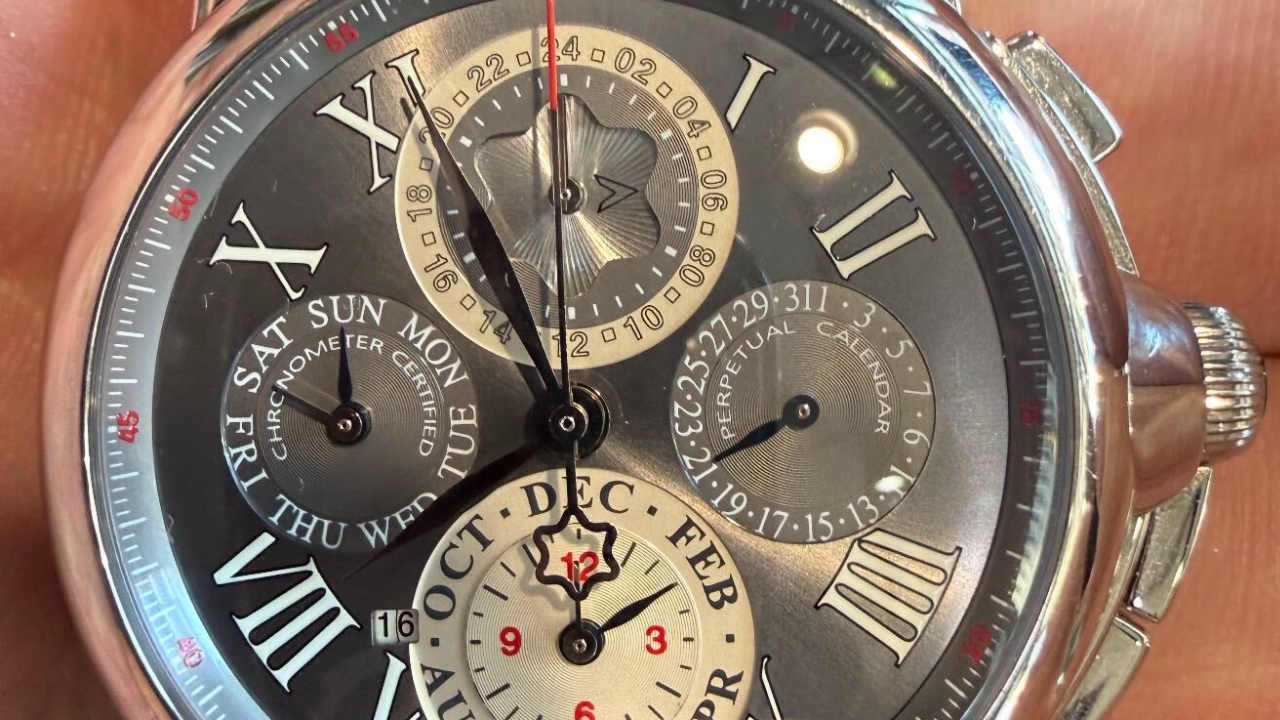
Saturday morning at Breakfast in the BatCave, one of the guys was showing me pictures of a watch.
I'm a bit of a watch geek, so this happens.
It was a beautiful limited-edition Montblanc. Perpetual calendar, automatic movement, all kinds of mechanical wizardry. One of only 100 made.
He told me the story of the original owner, who had purchased it overseas and left the elaborate presentation box and original paperwork behind.
Apparently, the box was something to behold. All kinds of special features. The kind of packaging you might expect when buying a very expensive timepiece.
Years later, the owner decided to sell the watch.
And prospective buyers kept asking the same question.
Where's the box and papers?
The watch was right there. You could hold it, examine it, open the back and inspect the movement. The limited-edition number was engraved into the case.
Still, the missing documentation was a problem.
That got me thinking.
Imagine two identical 1968 Porsche 911 Targas sitting side by side.
Same colour. Same options. Same mileage. Same condition.
An experienced appraiser goes over both cars. Paint depth, engine numbers, mechanical condition, patina. Everything checks out.
One car comes with a complete history. Original documents, ownership records, decades of service invoices.
The other comes with a set of keys.
Which sells for more?
Anyone who's spent time around collectible cars understands the question.
The paperwork doesn't make the documented Porsche mechanically superior. It gives you a better understanding of what happened to that car during the previous 58 years.
There are fewer unanswered questions.
The pedigree offers some comfort. Somebody has shaken the farts out of the blanket.
And there's a word for what we're talking about.
Provenance
I've been thinking about that word a lot lately.
Especially after something else caught my attention this weekend.
My social feeds have been filling up with fitness influencers who appear to be around my age.
Beautiful people in their fifties. Incredible physiques. Inspirational stories about getting healthy later in life.
Some are selling supplements. Others are promoting programs or products.
A few have enormous followings and engagement.
And some of these people appear to be entirely synthetic.
AI-generated faces, bodies, voices, and personal histories. Presented as real people who supposedly achieved real results using the products they're promoting.
I can't establish which particular accounts are synthetic simply by looking at them. That's precisely what bothers me.
The technology has become extraordinarily convincing.
Think about that for a moment.
Someone can manufacture a 55-year-old woman who looks fantastic, give her an inspiring personal story, build an audience around her, and have her recommend a product based on an experience she never had.
The person might never have existed. The product certainly does.
And someone is collecting the money.
The Federal Trade Commission has had rules against deceptive advertising and endorsements for a very long time. Its more recent attention to fake reviews, testimonials, and AI-generated representations is worth watching.
The underlying concern is familiar. People make purchasing decisions based on what they believe they're being shown.
When the representation is fabricated, that matters.
Meanwhile, the platforms have an interesting problem of their own.
Synthetic personalities can attract enormous attention. Attention generates engagement, and engagement is valuable.
How aggressively will platforms police material their users apparently enjoy consuming?
I suspect meaningful accountability will require a combination of consumer pressure, regulation, and technology.
We're already seeing some of the technological response.
C2PA, Content Credentials, AI-generated-content labels, and other methods of recording where digital material originated and how it was created.
They're imperfect. Metadata can disappear, and a verified origin doesn't guarantee the content is truthful.
Still, it's interesting that we're developing ways to establish the pedigree of a photograph.
We've been doing something similar with collectible cars for generations.
And I wonder where this goes.
Some people won't care whether the person entertaining them on Instagram actually exists.
I understand that.
If something makes you laugh for thirty seconds, does it really matter how it was created?
The answer might change when that same person asks you to buy something based on their supposed firsthand experience.
Or when the photograph you're examining is supposed to represent the actual used vehicle sitting on a dealership lot.
Or when you're considering someone for an important professional assignment.
Imagine two professionals with identical credentials. Same degree, same title, comparable experience.
Both appear perfectly qualified.
One has a substantial, accessible professional history. Original work you can examine. Documented appointments. Independent accounts of their experience.
The other has a nice biography and a LinkedIn profile.
You don't know either of them.
Which one gives you greater confidence?
The second person might be every bit as capable. Perhaps even better.
You simply have more questions about them.
And that's what keeps rattling around in my head.
We're entering a period when manufacturing the appearance of credibility has become remarkably easy.
At the same time, people have powerful new tools for investigating what they're being told.
I wonder whether the ability to establish provenance will become an important differentiator for businesses and individuals.
Maybe even something people are willing to pay a premium for.
After all, we already understand the value of a documented history when we're buying an old Porsche.
Why would we value it any less when we're deciding whom to trust?
And for those of us who grew up watching the old Memorex commercials, there's a funny twist to that familiar question.
Is it real, or is it Memorex?
These days, I'm beginning to wonder whether there was ever a real person in front of the microphone.
See you next Tuesday.
Bob

About Bob Manor
Bob Manor is an entrepreneur, writer, and founder of Influence.VIN, where he develops Recognition Engineering strategies that help established professionals, executives, and businesses make their real-world expertise discoverable, understandable, and verifiable in an AI-mediated world.
With 36 years of experience in the automotive industry, Manor has built and operated businesses spanning automotive remarketing, dealer services, technology, and media. His work draws on decades of firsthand experience with entrepreneurship, reputation, human behaviour, and the economics of trust.
He publishes Manorisms, exploring business, technology, identity, and the often-overlooked connections between them.
Disclaimer:
These are my own observations and interpretations, based on lived experience inside this industry.
This is not financial, legal, or professional advice ... it is pattern recognition, shared for awareness and strategic consideration only


Responses